
Bone Health After 40: Osteopenia, Vitamin D & Strength Longevity

There’s a quiet moment many women experience in their 40s or early 50s. Maybe it happens after a routine DEXA scan. Maybe it’s a twinge in the hips, a fracture that takes longer to heal, or the realization that strength doesn’t come as easily as it once did. You’re told you have osteopenia. Not osteoporosis—yet—but the warning light is on.
Here’s the empowering truth: bone loss after 40 is not a passive, inevitable decline. Bone is living tissue. It responds to nourishment, hormones, movement, stress, and even how safe and grounded your nervous system feels. When we combine the wisdom of Ayurveda with modern functional medicine, we get a roadmap that doesn’t just slow loss—but actively supports bone rebuilding, muscle integrity, and strength longevity.
This article is your guide to that integrated approach—grounded, practical, and deeply supportive of women in midlife.

Why Bone Density Changes After 40 (and Why It’s Not Just About Calcium)
From a Western perspective, bone loss accelerates during perimenopause and menopause due to declining estrogen, reduced muscle mass, and changes in vitamin D metabolism. From an Ayurvedic lens, this stage of life marks the transition into the Vata phase, a time governed by dryness, lightness, mobility, and depletion.
Both systems are describing the same reality—just in different languages.
Bone loss is influenced by:
Hormonal shifts (especially estrogen decline)
Reduced mechanical loading (less strength training)
Poor mineral absorption
Chronic stress and inflammation
Nervous system dysregulation
To truly rebuild bone, we must address all of these layers together.
Asthi Dhatu + Bone Health: The Ayurvedic Foundation of Bone Health After 40
In Ayurveda, Asthi Dhatu is the tissue responsible for bones, teeth, nails, and structural integrity. It is the fifth of the seven dhatus and is formed from meda (fat tissue), meaning bone health is inseparable from nourishment, digestion, and hormonal balance.
Critically, Asthi is the seat of Vata. When Vata becomes aggravated—as it naturally does with aging—bone tissue becomes dry, brittle, porous, and depleted. Classical descriptions of Asthi Dhatu Kshaya mirror modern osteopenia and osteoporosis almost perfectly: cracking joints, bone pain, dental weakness, brittle nails, hair thinning, and a sense of feeling “ungrounded” in the body.

Ayurveda teaches that weak bones are rarely a bone-only problem. They are a digestive, nervous system, and lifestyle issue first.
Key Ayurvedic principles for bone rebuilding:
Strengthen agni (digestion) so minerals are absorbed
Calm Vata through routine, warmth, and oil
Nourish earlier tissues (rasa, mamsa, meda) so Asthi can rebuild
Support hormonal transitions gently, not aggressively
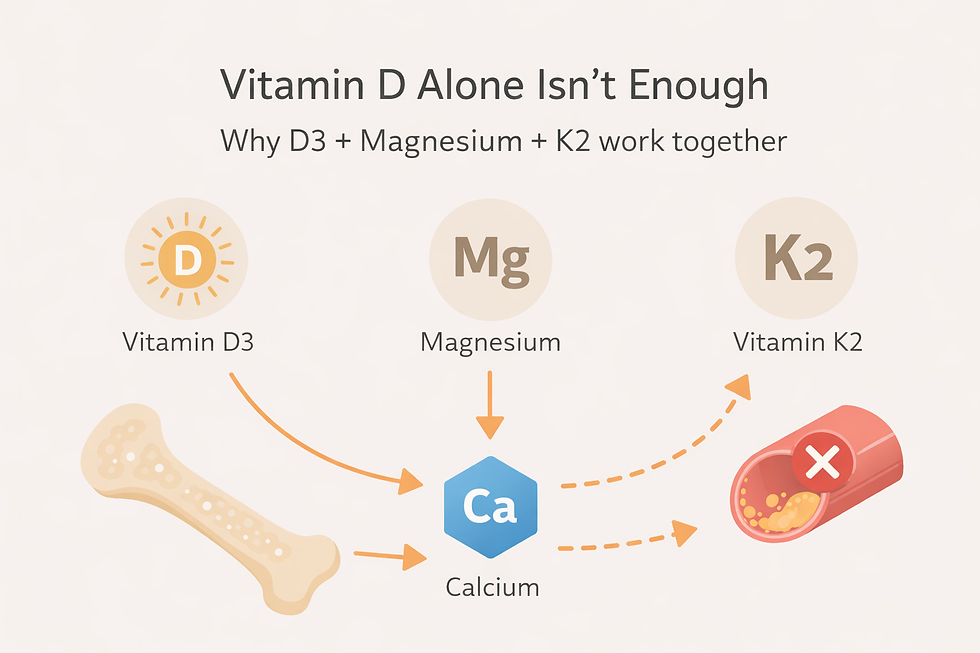
Vitamin D, K2 & Magnesium: The Non-Negotiable Synergy
One of the most common—and dangerous—mistakes in bone health is focusing on vitamin D alone.
Bone remodeling requires a coordinated system, not a single nutrient.
Vitamin D3
Increases calcium absorption from the gut
Supports osteoblast (bone-building cell) activity
Functions as a hormone, not just a vitamin
Without adequate D, calcium simply passes through the body unused.
Magnesium
Required for every enzymatic step that activates vitamin D
Deficiency can cause a functional vitamin D deficiency even when labs look “normal”
Essential for muscle contraction, balance, and fall prevention
Vitamin K2
Activates osteocalcin, which binds calcium into bone
Activates matrix Gla-protein, preventing calcium from depositing in arteries
Critical for safe, targeted mineral placement
Think of it this way: Vitamin D opens the door. Magnesium turns on the lights. K2 tells calcium exactly where to go.
Functional medicine consistently shows that D without magnesium and K2 underperforms—and may even increase risk.
Strength Training for Bone Remodeling: Your Most Powerful Medicine
Bones respond to load, not walking alone. They need a mechanical reason to stay dense. Through a process called mechanotransduction, bone cells sense stress and respond by laying down stronger matrix. Without this signal, bone defaults to resorption.
What the Evidence Shows
Resistance training 2–3x/week improves spine and hip bone density
Loads of ~50–85% of 1-rep max are most effective
Programs sustained for 6–12 months show measurable gains—even in postmenopausal women
Bone-Building Movements
Squats and sit-to-stands
Hip hinges (deadlifts, bridges)
Lunges and step-ups
Rows, presses, and carries
Balance work to reduce fall risk
Safety Matters
If you have osteopenia or osteoporosis:
Avoid loaded spinal flexion and twisting
Prioritize technique over intensity
Progress gradually, ideally with professional guidance
Strength training is not optional after 40—it’s foundational. It provides the signal. Nutrition provides the materials.

Ayurvedic Herbs That Support Bones, Muscles & Recovery
Ayurveda approaches bone health as a rasayana process—rejuvenation over time.
Key traditionally used herbs include
Hadjod (Cissus quadrangularis / Asthi Shrinkhala) : Known as the “bone-setter,” traditionally used for fractures and low bone density. Modern research suggests it supports osteoblast activity and mineralization.
Ashwagandha (Withania somnifera) : Supports muscle strength, stress resilience, sleep, and nervous system regulation—critical for sustaining strength training and reducing cortisol-driven bone loss.
Shatavari (Asparagus racemosus) : Especially supportive during menopause; nourishes tissues, supports calcium utilization, and addresses hormonally influenced bone loss.
Guggulu : Used for joints, inflammation, and mineral delivery; often paired with bone-supportive herbs.
These are not replacements for exercise or nutrition—they amplify the body’s adaptive response.

Warm Oils for Joint & Bone Nourishment
Oil is medicine in Ayurveda—especially for bones.
Regular warm-oil massage (abhyanga) pacifies Vata, improves circulation, reduces stiffness, and nourishes deeper tissues through the skin.
Best Oils for Ayurveda Bone Health
Sesame oil – deeply warming and penetrating
Mahanarayan Taila – for joints, soreness, post-exercise recovery
Dhanwantharam Taila – musculoskeletal rejuvenation
Simple Ritual
Warm oil gently (lukewarm, not hot)
Massage joints and muscles for 10–15 minutes
Use long strokes on limbs, circles on joints
Follow with a warm shower
This practice supports recovery, nervous system regulation, and long-term joint resilience.
Your Everyday Bone-Rebuilding Routine (Simple & Sustainable)
This is where everything comes together.
Daily
Eat warm, mineral-rich meals (leafy greens, sesame, quality protein)
Prioritize sleep and regular routines
Consider magnesium and K2 with vitamin D (with clinician guidance)
Abhyanga several times per week
Weekly
Strength train 2–3 non-consecutive days
Walk or do gentle yoga on off days
Include balance work
Seasonally
Reassess vitamin D levels
Adjust training intensity
Support digestion during transitions

A Grounded Path Forward: Build Bone Strength One Day at a Time
Your bones respond to what you do daily—not what you do occasionally. Instead of chasing supplements or fearing future scans, return to the simple Daily Bone Ritual outlined in this article. When you nourish digestion, load your muscles, balance vitamin D with magnesium and K2, and calm Vata through warmth and routine, you send your body a clear signal: build, stabilize, strengthen.
Start with one day. Then repeat. Over time, these daily signals compound—supporting bone density, muscle strength, joint resilience, and confidence in your body’s longevity.
A Simple, Ayurvedic + Functional Medicine Guide for Strong Bones After 40
Morning: Set the Foundation
☀️ Wake + Warm
Begin your day with warmth—warm water, herbal tea, or lemon water.
Avoid cold smoothies or iced drinks first thing; digestion sets the tone for bone nourishment.
🌿 Vitamin & Mineral Support(Discuss dosing with your clinician)
Vitamin D3
Magnesium (glycinate or citrate often preferred)
Vitamin K2 (MK-7)Together, these guide calcium into bone—not arteries.
Movement: Give Bones a Reason to Grow
🏋️ Strength Training (2–3x/week)Focus on slow, controlled, weight-bearing movements:
Squats or sit-to-stands
Hip hinges (deadlifts, bridges)
Lunges or step-ups
Rows, presses, carries
Bones strengthen in response to load. Walking alone is not enough.
🚶♀️ On Non-Lifting Days
Brisk walking
Gentle yoga
Balance exercises
Nourishment: Feed Asthi Dhatu
🍲 Eat Warm, Mineral-Rich Meals
Leafy greens, sesame seeds, nuts, legumes
Quality protein (eggs, dairy if tolerated, lentils, fish)
Healthy fats (olive oil, ghee, avocado)
🔥 Support Digestion
Favor cooked foods over raw
Use gentle spices (cumin, fennel, coriander)
Eat at regular times
Strong bones require strong digestion.
Evening: Calm Vata, Support Repair
🛢️ Warm Oil Massage (Abhyanga)
Warm sesame or Mahanarayan oil
Massage joints and muscles for 10–15 minutes
Shower warm afterward
Oil nourishes joints, calms the nervous system, and supports tissue repair.
🌙 Sleep + Routine
Aim for consistent bedtime
Reduce screens at night
Bone rebuilding happens during rest
Optional Ayurvedic Support
(Use with practitioner guidance)
Hadjod (Cissus quadrangularis) – bone strength
Ashwagandha – muscle recovery, stress resilience
Shatavari – menopausal bone support
Remember
You do not need to do everything perfectly.Consistency beats intensity.Your bones are listening—every single day.
Continue the series
Sexual Vitality and Libido in Midlife: An Ayurvedic Perspective
Natural Chronic Pain Relief: Midlife Pain Relief Through Ayurveda
Gut Health, Microbiome & Immune Aging: An Ayurveda Guide to Healthy Digestion After 40
The Longevity of Ritual: Why Ancient Practices Hold Clues to Aging Gracefully
The Stress Code: How Ancient Mindfulness Practices Buffer Epigenetic & Biological Aging
References
Ayurvedic Wellness Center. Understanding the dhatus: Asthi dhatu. Accessed Month Day, Year. https://ayurvedicwellness.center/blog/understanding-the-dhatus-asthi
Rushi Ayurveda. Asthi dhatu in Ayurveda: bone tissue explained. Accessed Month Day, Year. https://rushiayurveda.com/asthi-dhatu/
Planet Ayurveda. Asthi dhatu in Ayurveda and bone health. Accessed Month Day, Year. https://www.planetayurveda.com/asthi-in-ayurveda/
Journal of Ayurveda and Holistic Medicine. Asthi dhatu kshaya and vata imbalance. Accessed Month Day, Year. https://www.ayurvedjournal.com/JAHM_201626_08.pdf
Kottakkal Ayurveda. Ayurvedic analysis of low bone density (osteopenia and osteoporosis). Accessed Month Day, Year. https://www.kottakkal.shop/blogs/healing-with-kottakkal-ayurveda/ayurvedic-analysis-of-low-bone-density
Rasayana Ayurveda. Osteoporosis and Ayurveda: understanding bone depletion. Accessed Month Day, Year. https://rasayanaayurveda.co.in/blogs/Osteoporosis-and-Ayurveda
One World Ayurveda. Bone health through Ayurveda. Accessed Month Day, Year. https://oneworldayurveda.com/blog/bone-health-ayurveda/
National Center for Biotechnology Information (NCBI). Ayurvedic management of osteoporosis. Accessed Month Day, Year. https://pmc.ncbi.nlm.nih.gov/articles/PMC3456847/
Ayurvedic College. Asthi dhatu: a closer look at bone tissue. Accessed Month Day, Year. https://www.ayurvedacollege.com/blog/asthi-dhatu-a-closer-look-at-the-bones-from-the-ayurvedic-perspective/
Aston RX. The power of synergy: vitamin D3, K2, calcium, and magnesium for bone health. Accessed Month Day, Year. https://astonrx.com/blogs/read/the-power-of-synergy-the-importance-of-d3-k2-calcium-and-magnesium-for-bone-health
Mito Health. Magnesium and vitamin D synergy. Accessed Month Day, Year. https://mitohealth.com/guide/magnesium-with-vitamin-d-synergy
Memorial Longevity. Vitamin K2 and calcium placement in the body. Accessed Month Day, Year. https://www.memoriallongevity.com/vitamin-k2-calcium-placement
Frontiers in Nutrition. The role of magnesium in vitamin D activation and function. 2022;9:878665. https://www.frontiersin.org/journals/nutrition/articles/10.3389/fnut.2022.878665/full
National Center for Biotechnology Information (NCBI). Strength training and bone remodeling mechanisms. Accessed Month Day, Year. https://pmc.ncbi.nlm.nih.gov/articles/PMC10345999/
National Center for Biotechnology Information (NCBI). Mechanical loading and bone adaptation. Accessed Month Day, Year. https://pmc.ncbi.nlm.nih.gov/articles/PMC10543368/
Mayo Clinic. Osteoporosis and exercise: what you need to know. Accessed Month Day, Year. https://www.mayoclinic.org/diseases-conditions/osteoporosis/in-depth/osteoporosis/art-20044989
PubMed. High-intensity resistance training improves bone mineral density in postmenopausal women. Accessed Month Day, Year. https://pubmed.ncbi.nlm.nih.gov/40420105/
Nature Scientific Reports. Exercise, nutrition, and bone density outcomes. Accessed Month Day, Year. https://www.nature.com/articles/s41598-025-94510-3
Sri Sri Tattva. Ayurvedic oils for joint pain and muscle recovery. Accessed Month Day, Year. https://www.srisritattva.com/blogs/ageing-with-grace-and-ayurveda/ayurvedic-oils-joint-pain-muscle-recovery
Banyan Botanicals. Abhyanga: Ayurvedic self-oil massage. Accessed Month Day, Year. https://www.banyanbotanicals.com/pages/ayurvedic-self-oil-massage


Comments